Types of Judicial Processes in Ecuador (updated 2026)
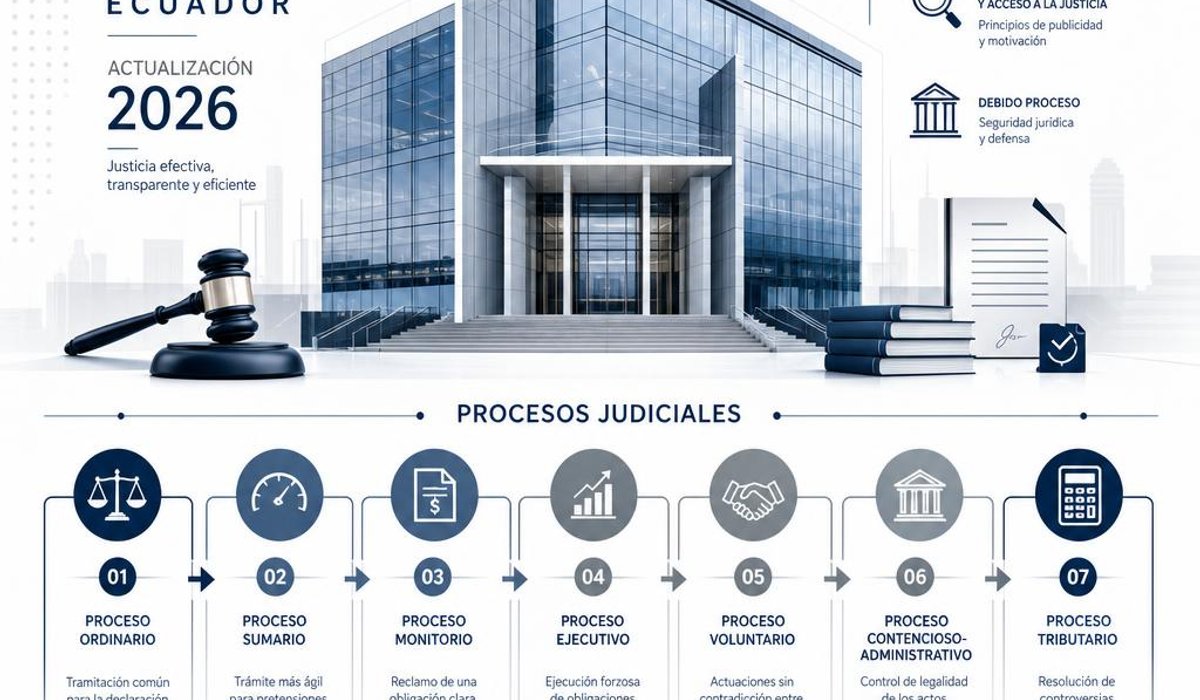
In Ecuador, judicial proceedings are organized according to the subject matter and applicable regulations. The General Organic Code of Processes (COGEP) regulates non-criminal cases through ordinary, summary, monitorio, executive, and voluntary procedures, as well as contentious-administrative and tax channels.
Types of judicial processes in Ecuador (updated 2026): complete guide to COGEP, criminal and other matters
In Ecuador, the types of judicial processes depend on the subject matter and the applicable regulations. The General Organic Code of Processes (COGEP) is the basis for non-criminal cases (civil, labor, childhood and adolescence, administrative contentious, tax, among others). Knowing these procedural routes is essential to understand how to act in the face of a judicial dispute, what stages are followed, and what requirements are demanded.
Below, the processes regulated by COGEP, special procedural areas, and official references to consult files or delve into the regulations are explained.
1. Processes regulated by COGEP (non-criminal matters)
COGEP concentrated procedural dispersion into four main routes —ordinary, summary, monitoring, and executive— to which voluntary procedures and contentious administrative and tax routes are added.
1.1. Ordinary procedure
It is the residual and broadest route. It applies to complex matters or those without a special assigned procedure. It is carried out in two hearings: a preliminary one (where the object of the dispute is set and evidence is admitted) and a trial hearing (where evidence is presented and argued). It is the proper channel for many civil, commercial, and family conflicts that exceed the thresholds of the summary procedure.
1.2. Summary procedure
It is designed for specific disputes that the law enumerates exhaustively, such as certain labor matters, childhood and adolescence, or tenancy. It is resolved in a single hearing, making it faster than the ordinary procedure. Its scope is limited to expressly provided cases; outside of them, the ordinary procedure must be used.
1.3. Monitoring procedure
It is a documentary and summary process aimed at collecting determined, liquid, enforceable, and overdue debts that are not recorded in an executive title. The amount cannot exceed fifty unified basic salaries (SBU) of the general worker (Art. 356 of COGEP). It begins with an ex parte payment order; the debtor has fifteen days to pay or oppose. If they do not, the order becomes final and execution proceeds. It is a key tool for collecting invoices, personal loans, or credit card debts lacking a classic executive title.
1.4. Executive procedure
It seeks compliance with or collection of clear, pure, determined, and currently enforceable obligations backed by an executive title. Art. 347 of COGEP lists these titles: sworn statements, public deeds, recognized private documents, bills of exchange, promissory notes to order, wills, extrajudicial settlements, and those granted such status by other laws. The obligation must also be liquid or liquidable by arithmetic operation. It is the route to enforce promissory notes, bills of exchange, or final judgments, among others.
1.5. Voluntary procedures
They are used when there is no conflict between parties and judicial authorization or intervention is required for certain acts. COGEP regulates them for procedures such as guardianship, curatorship, inventory formation (for example, in the dissolution of marital property) or the opening of successions. Their nature is non-contentious: the judge verifies compliance with legal requirements and authorizes the request.
1.6. Administrative contentious and tax contentious
These are special routes to resolve disputes against acts, contracts, or actions of the public administration (administrative contentious) or in tax matters (tax contentious). Depending on the action (subjective or objective), they may follow the ordinary or summary procedure. In the tax field, for example, after exhausting the administrative route, the taxpayer may sue before the Tax Contentious Tribunal, complying with the requirements of Art. 142 of COGEP.
2. Other procedural areas in Ecuador
2.1. Criminal process (COIP)
It is governed by the Comprehensive Organic Criminal Code (COIP) and not by COGEP. Its structure is accusatory and oral. The main phases are: preliminary investigation (the Prosecutor's Office gathers evidence for and against the accused); fiscal instruction (hearing for the formulation of charges, with a maximum term of ninety days, except for exceptions); evaluation and preparation for trial (the judge assesses if there are grounds to call for trial); and trial (oral and public debate stage before the criminal guarantees court). These phases may be followed by an appeal stage through remedies such as appeal or cassation.
2.2. Constitutional, electoral, and asset forfeiture processes
They have their own regulations and procedures, distinct from COGEP.
Constitutional processes: governed by the Organic Law of Jurisdictional Guarantees and Constitutional Control (LOGJCC) and the Constitution. They include protection actions, habeas corpus, habeas data, access to public information, and constitutional control, among others.
Electoral processes: are heard before the National Electoral Council (CNE) and the Electoral Contentious Tribunal, according to the Organic Electoral Law and Political Organizations (Code of Democracy).
Asset forfeiture: governed by the Organic Law of Asset Forfeiture (LOED). The Constitutional Court, in ruling 8-22-IN/26 of July 2026, declared asset forfeiture and the early disposal of assets constitutional, dismissing an unconstitutionality action and confirming the validity of the legal framework to pursue assets of illicit origin.
3. How to consult files or judicial procedures in Ecuador?
The Judiciary Council provides citizens with the Case Consultation system, a free digital tool that allows reviewing the status of ongoing or completed judicial processes. Searches can be made by name, ID number, or case number, and the service is available permanently.
Basic steps:
1. Enter the official portal of the Judicial Branch: www.funcionjudicial.gob.ec
2. Select the option "Case Consultation" or access the SATJE system directly: https://procesosjudiciales.funcionjudicial.gob.ec/busqueda
3. Choose the type of search and enter the data (name, ID number, or case number).
4. Review the results and access the case details.
The consultation is public and free, except in cases with restricted access by law (for example, cases involving minors or domestic violence).
Update note: this article was reviewed and updated in November 2026. Always verify the validity of links and regulations on official portals, as laws and platforms may undergo reforms. For a specific case, professional legal advice is recommended.